Meta-Dimensional Structures
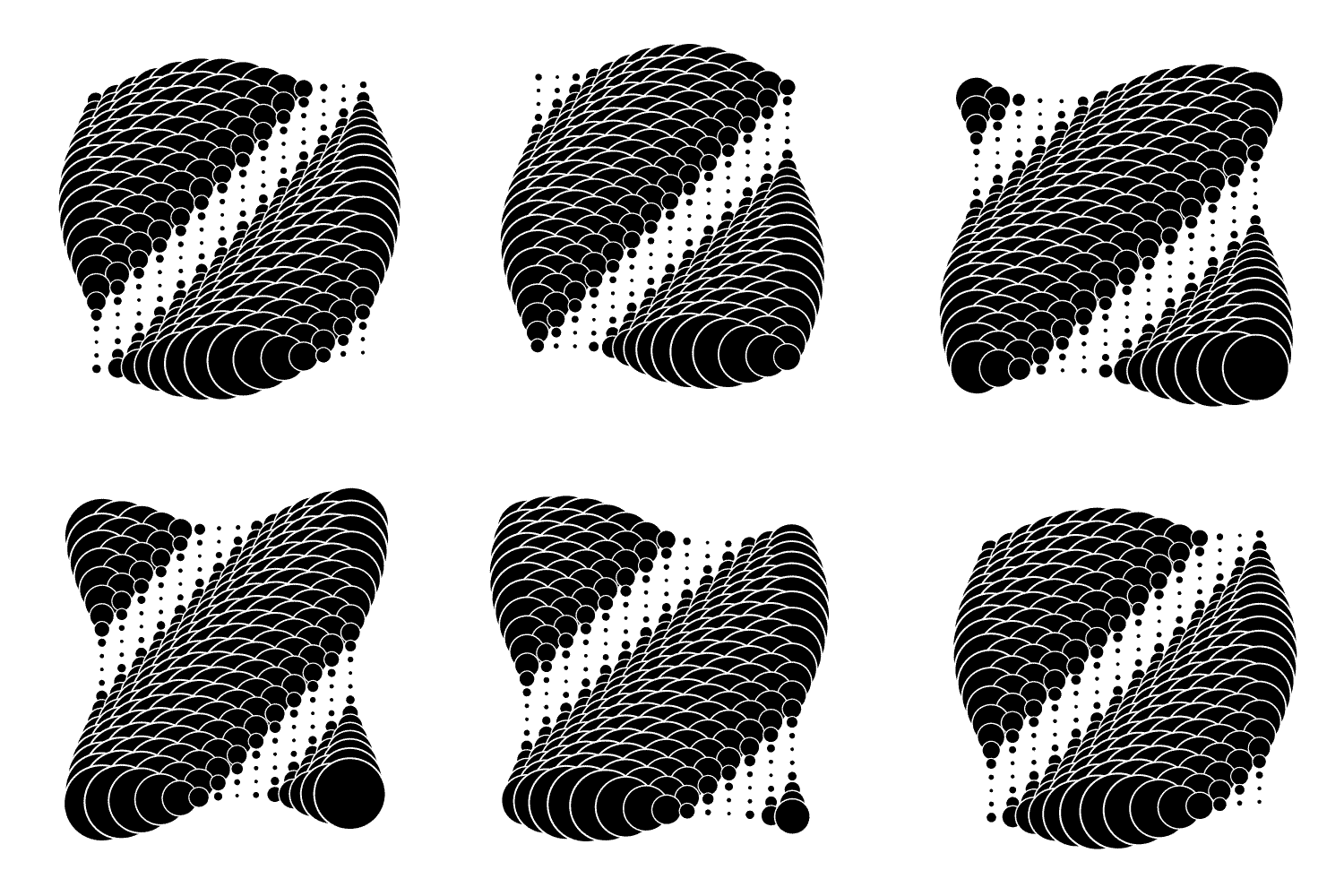
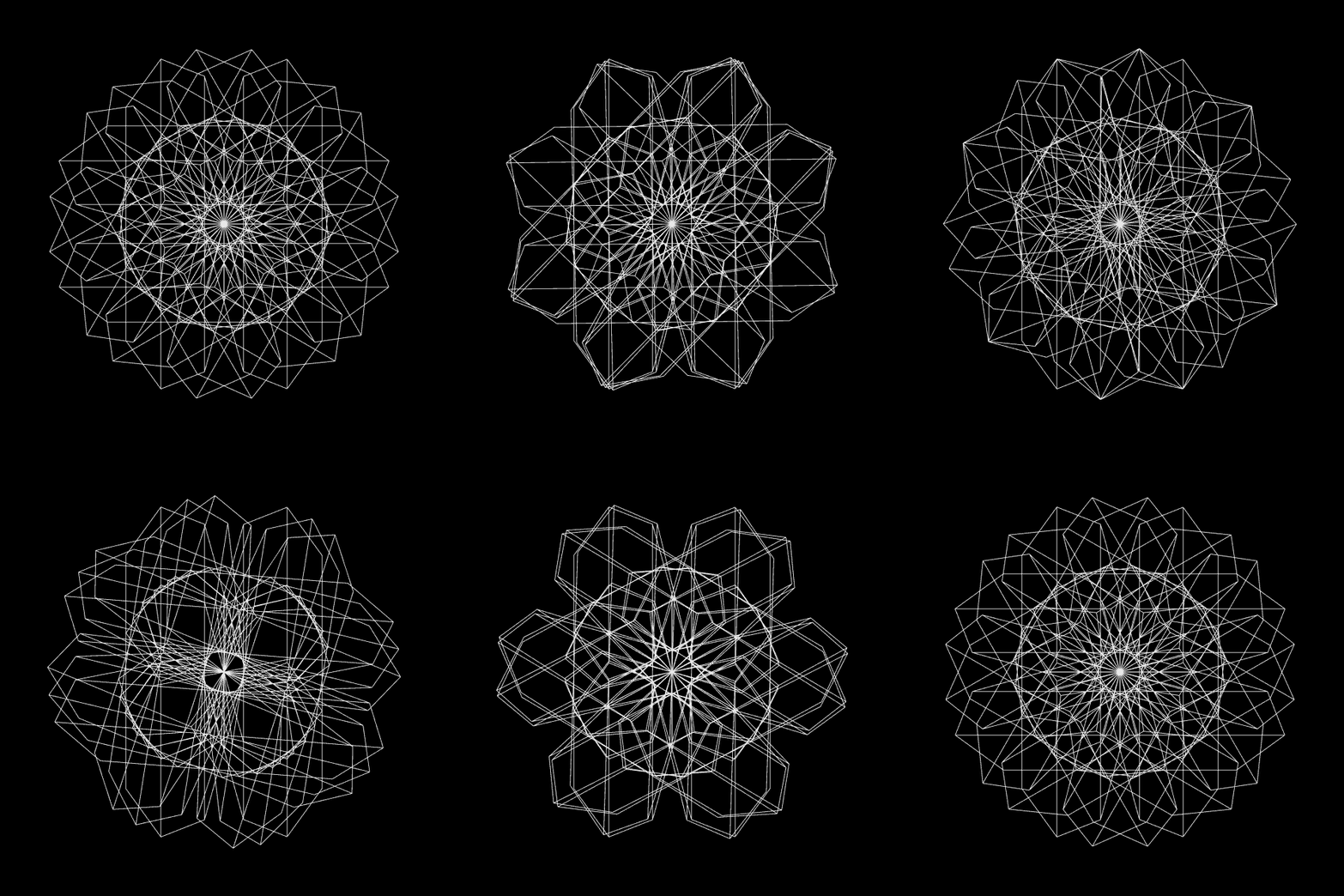
Meta-Dimensional Structures are conceptual entities that exist beyond the traditional frameworks of space and time. These structures provide a profound and often challenging perspective on the nature of reality, offering insights that extend beyond our conventional understanding of dimensionality. By exploring these structures, we can develop new models and frameworks that may redefine fundamental principles in both theoretical and applied physics.
Conceptualizing Meta-Dimentional Structures
Meta-dimensional structures can be described mathematically by extending traditional vector space concepts to infinite-dimensional Hilbert spaces. These spaces, denoted as 𝐻, are complete inner product spaces that allow for the generalization of finite-dimensional Euclidean spaces to an infinite number of dimensions. In this context, each vector in 𝐻 can represent a state of a meta-dimensional entity, with operations such as addition and scalar multiplication retaining the familiar properties seen in lower-dimensional spaces.
Consider a function: 𝜓: 𝑅^𝑛 → 𝐻
where 𝜓 maps points in n-dimensional space to vectors in an infinite-dimensional Hilbert space. The function 𝜓 could represent a projection from the higher-dimensional meta-space to the observable space-time dimensions.
Illustration

Physical Implications
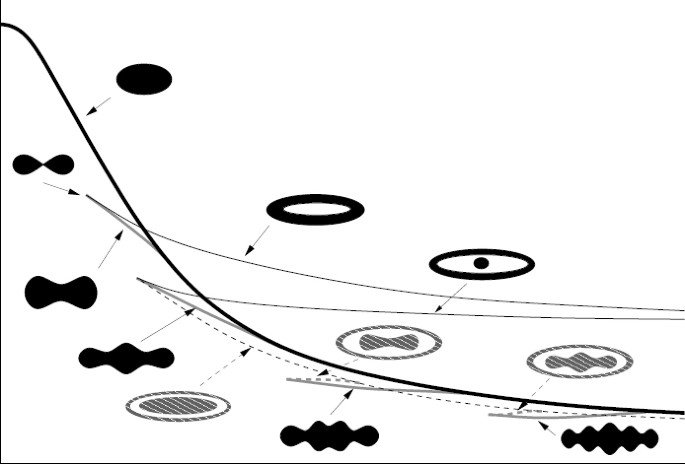
Meta-dimensional structures suggest the existence of physical phenomena that cannot be fully explained within the Standard Model of particle physics. For instance, the interactions between particles could be influenced by forces that originate in these higher-dimensional spaces, but manifest in our four-dimensional spacetime as what we perceive as gravity, electromagnetism, and the nuclear forces.
One possible implication is the existence of “dark dimensions”—extra dimensions beyond the familiar three spatial and one temporal dimension, which could provide a natural explanation for dark matter and dark energy.
The dynamics within these meta-dimensions could exert an influence on the curvature of spacetime, as described by the generalization of Einstein’s field equations:
Rμν − 21gμνR + Λgμν + ξTμν = c48πGTμν
represents an additional term that accounts for the influence of meta-dimensional structures.
This term could provide a modification to general relativity, potentially offering new insights into the acceleration of cosmic expansion and the behavior of dark matter.
Here, ξTμν represents an additional term that accounts for the influence of meta-dimensional structures. This term could provide a modification to general relativity, potentially offering new insights into the acceleration of cosmic expansion and the behavior of dark matter.
Revisiting the Ontology of Dimensions
Philosophically, meta-dimensional structures challenge our traditional ontology of dimensions. If these structures exist, they suggest that our universe’s apparent dimensionality is merely a projection of a far more complex, underlying reality. This idea resonates with the philosophical position known as structural realism, which posits that the structure of the world, rather than the objects themselves, is what is fundamentally real.
This view leads to a reconsideration of space and time as emergent phenomena, rather than fundamental aspects of reality.
In this framework, space and time might be understood as by-products of the interaction between meta-dimensional entities, much like temperature is an emergent property of the kinetic energy of particles in statistical mechanics.
Empirical Predictions and Observational Mechanisms
Experiments such as those conducted by the Laser Interferometer Gravitational-Wave Observatory (LIGO) could be adapted to search for anomalies in gravitational wave patterns that suggest interactions with meta-dimensional structures.
Additionally, the Large Hadron Collider (LHC) or future colliders could be used to search for evidence of particles that exist in meta-dimensional spaces. These particles might have masses or charges that do not fit within the Standard Model, or they might interact with known particles in ways that suggest they are influenced by extra-dimensional forces.
Concrete Mechanisms: Meta-Dimensional Projections and Quantum Fields
A concrete mechanism by which meta-dimensional structures could influence observable phenomena is through the projection of quantum fields. In quantum field theory (QFT), fields are typically defined over four-dimensional spacetime. However, if these fields are actually projections of higher-dimensional quantum fields, then their behavior could be influenced by the topology and geometry of the meta-dimensional space.
For example, the vacuum expectation value (VEV) of a scalar field in four-dimensional spacetime might be affected by boundary conditions imposed in higher dimensions, leading to observable effects such as spontaneous symmetry breaking or the generation of mass. The effective field theory that results from this projection could exhibit novel terms that modify the Higgs potential or introduce new interaction terms.
Additionally, the Large Hadron Collider (LHC) or future colliders could be used to search for evidence of particles that exist in meta-dimensional spaces. These particles might have masses or charges that do not fit within the Standard Model, or they might interact with known particles in ways that suggest they are influenced by extra-dimensional forces.
Models and Simulations: Exploring Meta-Dimensional Dynamics
To explore the implications of meta-dimensional structures, numerical simulations can be employed. These simulations would model the behavior of meta-dimensional entities and their projections into lower-dimensional space. By varying the parameters of the higher-dimensional space, such as its curvature or connectivity, researchers can investigate how these factors influence the resulting physical laws and constants.
One approach is to use lattice quantum field theory (LQFT) to discretize both the lower-dimensional spacetime and the meta-dimensional space. This allows for the numerical study of quantum fields that extend into higher dimensions, providing insights into how meta-dimensional structures might influence phenomena such as particle masses, coupling constants, and the cosmological constant.
Meta-Dimensional Structures as the Architecture of Reality
Analogy