
Helmas Theory
Foundations of Meta-Dimensional Studies
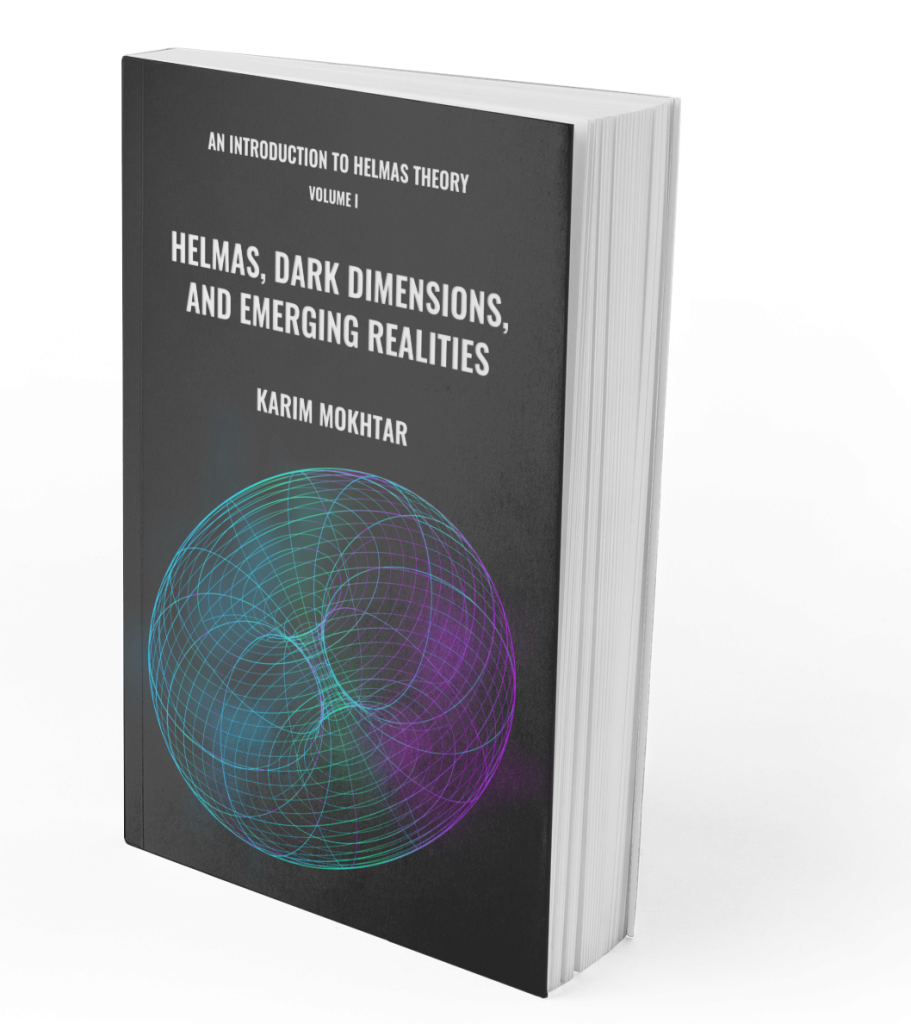
HELMAS, DARK DIMENSIONS, AND EMERGING REALITIES
An Introduction to Helmas Theory, Volume 1
Latest article on Academia
Rethinking Early Universe Dynamics and Singularities through Time Compression and Multidimensional Time
This article addresses the unexpected rapid formation of massive galaxies in the early universe and the complex behavior of time near singularities by proposing a novel framework that introduces the concepts of time compression and multidimensional time. By developing a mathematical model where the rate of time progression varies across space and time, this paper provides an alternative explanation to existing cosmological models, potentially resolving observed anomalies in galaxy formation and offering new insights into the nature of time near extreme gravitational fields. The framework lays the groundwork for further theoretical exploration and empirical testing, advancing our understanding of cosmic evolution and the fundamental nature of time.
Meta-Dimensional Structures
Meta-dimensional structures provide a profound understanding of infinite-dimensional entities that transcend traditional space-time frameworks. These structures challenge our conventional notions of dimensionality, offering new perspectives on the fundamental nature of the universe. By exploring the properties and behaviors of these meta-dimensional entities, we gain insights into the underlying architecture of reality, potentially leading to groundbreaking discoveries in both theoretical and applied physics.
Projections of Higher Realities
The mechanisms by which higher-dimensional entities project into our observable three-dimensional space and one-dimensional time reveal deeper cosmic truths. This projection theory posits that our perceivable universe is but a shadow of a more complex higher-dimensional reality. Understanding these projection mechanisms could unlock answers to longstanding cosmological puzzles and provide a framework for integrating various physical phenomena under a unified theory.
Temporal-Spatial Intersections
The dynamic interactions between temporal and spatial dimensions have significant implications for our understanding of reality. By examining how these dimensions intersect and influence each other, we can develop new models that better explain the behavior of complex systems. These intersections may also shed light on phenomena such as the nature of time, the fabric of space, and the intricate dance between them that defines our universe.
Consciousness as a Projection
Human consciousness as a limited projection of a vast, multi-dimensional meta-consciousness structure offers groundbreaking insights into cognitive science and philosophy. This theory suggests that our conscious experience is merely a slice of a much broader and richer meta-consciousness. Exploring this idea could revolutionize our understanding of the mind, consciousness, and their connections to the physical world, potentially leading to new technologies for enhancing human cognition.
Operadic Algebra Framework
The application of operadic algebra to describe and analyze complex interactions between higher-dimensional structures introduces a novel mathematical framework. Operads, which capture the essence of operations with multiple inputs and outputs, provide a powerful tool for modeling the intricate relationships within and between Helmas. This framework could pave the way for new advancements in both pure and applied mathematics, offering a deeper understanding of the algebraic properties of meta-dimensional entities.
Dark Dimensions & Hidden Realities
The hypothesis of dark dimensions provides a new framework for understanding phenomena such as dark matter and dark energy. These dimensions, which exist beyond our perceptual capabilities, may interact with our universe in subtle yet profound ways. By exploring the properties and behaviors of these dark dimensions, we can develop new theories that better explain the mysterious components of the cosmos and their influence on the observable universe.
Polylogic & Computational Frameworks
Polylogic, a set of advanced logical frameworks used by various forms of consciousness, presents novel approaches to reality interpretation. These multiple logics, each suited to different contexts and tasks, reflect the diversity and adaptability of cognitive processes. Understanding and developing Polylogic could lead to significant advancements in artificial intelligence, cognitive science, and our understanding of how different beings perceive and interact with their environments.
Quantum Interactions Beyond Perception
Quantum-level interactions that remain hidden from our perception are crucial for a comprehensive understanding of reality. These interactions, governed by the principles of quantum mechanics, reveal a layer of complexity and nuance that is not immediately apparent. Investigating these hidden quantum phenomena can lead to new discoveries in physics, enhancing our understanding of the fundamental forces and particles that make up the universe.
Meta-Abstract Dynamics
Dynamic laws governing the behavior and interaction of meta-abstract entities influence our universe in profound ways. These laws, which describe the interactions between higher-dimensional structures, can provide insights into the fundamental principles that govern reality. By studying these dynamic laws, we can develop new theoretical models that better explain the complexities of the cosmos and predict new phenomena.
Unbounded & Uncountable Meta-Ideas
Meta-ideas that are neither finite nor infinite challenge current mathematical and philosophical paradigms. These unbounded concepts push the limits of our understanding, suggesting that there are aspects of reality that cannot be fully captured by traditional notions of quantity and measure. Exploring these meta-ideas could lead to new mathematical theories and philosophical insights, expanding our conceptual toolkit for understanding the universe.
Non Temporal Changes in Reality
Non-temporal changes driven by higher-dimensional influences offer a novel perspective on the evolution of the universe. These changes, which do not conform to our usual understanding of time, suggest that there are other forms of dynamics at play. By investigating these non-temporal phenomena, we can develop new theories that encompass a broader range of possibilities, providing a more complete picture of how the universe evolves.
Inter-Universe Relationships
Complex relationships between different universes within the multiverse are defined by unique intersections of higher-dimensional structures. These interactions between universes suggest that our reality is part of a vast and interconnected multiverse. Understanding these relationships can provide insights into the nature of the multiverse, the fundamental laws that govern it, and the potential for interactions between different universes.
Higher Dimensional Geometries
The geometry of higher-dimensional spaces offers insights into the structure and behavior of the cosmos. These geometric frameworks extend beyond our three-dimensional intuition, providing a more comprehensive understanding of space and its properties. By studying higher-dimensional geometry, we can develop new mathematical tools and theories that enhance our ability to model and understand the universe.
Perceptional Limitations of Human Cognition
The inherent limitations of human cognition in perceiving higher-dimensional realities are explored, revealing the constraints of our sensory and cognitive systems. These limitations suggest that there are aspects of reality that are fundamentally beyond our perception. By understanding these perceptual constraints, we can develop new technologies and methodologies to extend our cognitive capabilities and explore the hidden dimensions of reality.
The Nature of Time in Higher Dimensions
The nature of time in higher-dimensional spaces presents new theoretical challenges and opportunities. Time, as we perceive it, may be just one aspect of a more complex temporal structure. Exploring the nature of time in these higher dimensions can lead to new insights into the fundamental nature of reality and the laws that govern it.
Multi-Dimensional Consciousness States
States of consciousness extending beyond human experience suggest the existence of multi-dimensional cognitive frameworks. These states, potentially accessible through advanced meditation, psychoactive substances, or future technologies, reveal the vast potential of consciousness. Studying these multi-dimensional states can provide new insights into the nature of the mind and its capabilities.
Mathematical Models of Helmas
Mathematical models provide a formal structure for understanding the properties and dynamics of Helmas. These models, based on advanced mathematical principles, offer a rigorous framework for exploring the complex interactions between higher-dimensional entities. Developing these models can lead to new discoveries in both mathematics and physics, enhancing our understanding of the universe.
Energy & Matter in Higher Dimensions
The behavior of energy and matter within higher-dimensional spaces is examined, revealing unexpected properties and interactions. These higher-dimensional frameworks can provide new insights into the fundamental nature of energy and matter, potentially leading to new theories that unify the forces of nature and explain phenomena that remain mysterious in current physics.
Non-Linear Causality in Meta-Dimensions
Nonlinear causality within meta-dimensional spaces challenges traditional notions of cause and effect. These nonlinear interactions suggest that the fundamental principles governing reality may be more complex than currently understood. Exploring nonlinear causality can provide new insights into the nature of time, space, and the interactions between them.
Symmetries & Invariances in Helmas
Symmetries and invariances in the structure of Helmas reveal fundamental principles governing their behavior. These symmetries, which may extend beyond our usual three-dimensional understanding, can provide insights into the fundamental laws of nature. Studying these symmetries and invariances can lead to new theoretical models and a deeper understanding of the universe.
Philosophical Implications of Meta-Dimensions
The existence of meta-dimensional structures has profound philosophical implications for understanding reality. These implications challenge our traditional notions of existence, knowledge, and perception, suggesting new ways of thinking about the nature of reality. Exploring these philosophical questions can provide new insights into the relationship between mind and matter, and the fundamental nature of the universe.
The Role of Helmas in Cosmology
Helmas play a critical role in shaping the large-scale structure and dynamics of the cosmos. These higher-dimensional entities influence the behavior of galaxies, the distribution of matter, and the evolution of the universe. Understanding the role of Helmas in cosmology can provide new insights into the fundamental forces that shape our universe.
Theoretical Physics & Helmas
The integration of Helmas into theoretical physics provides new avenues for research and discovery. These higher-dimensional entities offer a new framework for understanding the fundamental laws of nature, potentially leading to breakthroughs in our understanding of the universe. Exploring the theoretical implications of Helmas can provide new insights into the nature of reality and the fundamental principles that govern it.
Experimental Approaches to Higher Dimensions
Speeds in Alternate Universes
Dark Mathematics & Meta-Numbers
Meta-Dimensional Forces
Unified Field Theory
Interfacing the Human Brains with Higher Realities
Life's Evolution Across the Multiverse
The Dynamics of Universal End States
Mechanisms for Inter-Universal Life Transfer
Apply to create your account
Join the forefront of scientific discovery with Helmas Theory. Researchers and independent scholars are invited to request an account to access exclusive resources, collaborate on groundbreaking research, and contribute to the development of this innovative framework. Discover both the beauty and complexities of meta-dimensional entities and their interactions with our universe, and help shape the future of theoretical physics, cosmology, and cognitive science. Be part of a dynamic community pushing the boundaries of human knowledge!